Lara Trump, former president Donald Trump’s daughter-in-law and wife of Eric Trump, made a series of misleading claims in a major broadcast interview on The Breakfast Club this week.
Lara has been involved in her father-in-law’s political career since the 2016 election. The former president endorsed her for co-chair of the Republican National Committee in February 2024 and she was elected the following month.
Having interviewed Vice President Kamala Harris last week, Charlamagne tha God and fellow Breakfast Club hosts DJ Envy and Jess Hillarious sat down with Lara on Monday, who ended up making several misinformed and dubious points on January 6, Ukraine and the economy. Newsweek has contacted a media representative for the Republican National Committee via email for comment.
Lara Trump speaking during the 10X Ladies Conference Miami 2024 at JW Marriott Miami Turnberry Resort & Spa on August 16, 2024, in Aventura, Florida. She made several misleading comments during a recent podcast. Lara Trump speaking during the 10X Ladies Conference Miami 2024 at JW Marriott Miami Turnberry Resort & Spa on August 16, 2024, in Aventura, Florida. She made several misleading comments during a recent podcast. Ivan Apfel/Getty Images
Deaths on January 6
As she refuted claims about the severity of the actions on January 6, Lara said that only one person had died the day the Capitol was attacked.
“…The only person who died was a woman who was there actually very supportive of Donald Trump on that day,” she said.
Lara is referring to Ashli Babbitt, the 35-year-old military veteran who was shot by a law enforcement officer while entering the Speaker’s Lobby inside the Capitol.
However, Babbit wasn’t the only person who died on January 6.
Brian Sicknick, a Capitol Police officer and 42-year-old Iraq War veteran, was injured while physically engaging with protestors and collapsed upon returning to his division office. The medical examiner for Washington, D.C., said Sicknick, who suffered two strokes, died of natural causes.
Julian Khater, then 34, of New Jersey was sentenced in 2023 to more than six years in prison for using pepper spray to assault officers including Sicknick. Khater’s friend and co-defendant George Tanios, 41, was sentenced in 2023 to time already served having spent nearly six months in jail before an appeals court ordered his release, as reported by the Associated Press.
Kevin Greeson, 55, of Alabama, fell onto the sidewalk during the riots and died from natural causes of hypertensive atherosclerotic cardiovascular disease, according to the medical examiner. Benjamin Phillips, 50, of Pennsylvania, also died of natural causes from hypertensive atherosclerotic cardiovascular disease. Roseanne Boyland, 34, of Georgia, died from acute amphetamine intoxication. Her death was ruled an accident by Washington, D.C.’s chief medical examiner.
Four police officers also died by suicide following the insurrection: Metropolitan Police Department Officers Gunther Hashida, Kyle DeFreytag, Jeffrey Smith, and U.S. Capitol Police Officer Howard Liebengood.
Liebengood, 51, died three days after the riot. An official cause of death was not announced but according to his widow, the officer was sleep-deprived in the days following January 6. He took his own life at home after a work shift.
Smith, 35, was struck by a metal pole thrown by rioters that hit his helmet and face shield. His wife Erin told The Washington Post last February that her husband “wasn’t the same” in the days following the riots.
Smith was given a short medical leave but was told to return to work despite his wife later saying he was in considerable physical and emotional pain. He took his life on January 15, 2021.
Hashida, 43, and DeFreytag, 26, both died in July 2021.
Denies that Biden drilled more oil
As Lara spoke about Trump’s plans to increase drilling across the U.S., Charlamagne tha God said that “Biden has drilled more than Trump.”
“I don’t believe that’s true at all,” Lara replied.
It was reported in January 2024 that American oil production reached its largest volume in recorded history, more than 13.2 million barrels per day in October, official figures showed, outpacing the highest point under Donald Trump’s presidency, 13 million barrels daily in November 2019.
Analysis by The Washington Post, based on data from the Bureau of Land Management also showed that during his first three years in office, Biden oversaw the approval of 178 more drilling permits, compared to Trump.
Trump’s Real Estate History and the Central Park Five
DJ Envy asked Lara what she thought of the perception that her father-in-law is racist, mentioning the 1973 Trump housing lawsuit and his comments about the Central Park Five.
Lara replied that there was “never any proof of anything” in the case of the 1973 housing lawsuit when the Department of Justice sued Trump Management for allegedly discriminating against Black people applying to be tenants at their properties. The company was run by Donald Trump’s father Fred Trump, with Donald set to take over at the time.
The suit was settled, allowing the parties to end the dispute without admitting fault. However, Lara’s contention that there was “never any proof” of discrimination is her judgment, not a matter of fact. The FBI has published materials from its investigations conducted between 1972 and 1974.
Lara then made a confusing statement about the Central Park Five. In 1989, five Black teenagers were wrongly accused and convicted of the rape and assault of 28-year-old investment banker Trisha Meili while she was jogging in New York’s Central Park. Antron McCray, Kevin Richardson, Yusef Salaam, Raymond Santana and Korey Wise said they were coerced into giving false confessions by a prosecution spearheaded by Linda Fairstein, head of the sex crimes unit at the Manhattan District Attorney’s Office, before being convicted for crimes they did not commit.
The five, now all in their 50s, were exonerated in 2002 when serial rapist and murderer Matias Reyes confessed to being the one who attacked Meili. The five then sued New York City but did not receive a settlement until 2014.
Despite their exoneration, Donald Trump has continued to argue their guilt.
“There were so many people. You had a Democrat Governor, a Democrat DA who prosecuted those guys and they admitted to it…” Lara said.
This may mean that there were Democratic politicians involved in the conviction and pursuit of the Central Park Five, such as former Democratic governor Mario Cuomo, which is accurate, or, in addition to that, the claim that the Central Park Five admitted to their charges.
As reported by PolitiFact, the five admitted early to taking part in an attack, but withdrew confessions and none confessed to raping a woman in Central Park, and their convictions were vacated when the actual culprit proved his guilt.
The Central Park Five filed a defamation lawsuit against former President Donald Trump this week, prompted by Trump’s recent remarks during the September 10 presidential debate with Vice President Kamala Harris when he falsely claimed that the men were responsible for the crime and that the victim in the incident had died.
Misleads on Ukraine and Immigration
Lara was later asked about how Republicans had killed the bipartisan border bill at the request of Trump earlier this year.
In February, the Republican-led House struck down a bill that would have increased U.S. Immigration and Customs Enforcement detention capacity and allocated $20 billion to immigration enforcement. It has been argued that Trump was influential in convincing House Republicans to oppose the bill. Critics say it was a deliberate move to derail immigration victories Democrats could claim ahead of the 2024 election.
In response, she claimed the bill had also provided “$60 billion for Ukraine” and would have allowed “1.8 million illegal immigrants into our country a year.” The first point misses context and the second is misleading.
While the bill would have included $60.84 billion in spending on Ukraine, $23.2 billion would have been dedicated to replenishing weapons and ammunition systems for the U.S. military, and $13.8 billion for the purchase of weapons from the U.S., money that would have ended up in the hands of domestic weapons manufacturers.
“This deal will also help us invest in our own defense industrial base, supporting American jobs across the country and to help — help our ability to produce weapons and equipment that the United States can send to Ukraine, again, to help them continue to battle back against Russian aggression,” a senior White House official said in February 2024.
The legislation also stated that Department of Homeland Security Secretary Alejandro Mayorkas “shall activate the border emergency authority if, during a period of seven consecutive calendar days, there is an average of 5,000 or more aliens who are encountered each day…or on any one calendar day, a combined total of 8,500 or more aliens are encountered.”
If a hypothetical 5,000 migrants were encountered daily for a 365-day period, it would equate to approximately 1.825 million migrants, in line with Lara Trump’s claim.
However, that estimation has been dismissed by those involved in the bill’s sponsorship. Republican Senator Senator James Lankford, one of the bill’s co-sponsors, told Fox and Friends, “We’ve got to be able to have something that mandatorily deports everyone rather than actually releases everyone.
“That’s what this does. Some people are thinking this is somehow like counting 5,000 in every day or releasing them. That’s absurd.”
“The emergency authority is not designed to let 5,000 people in, it is designed to close the border and turn 5,000 people around,” Lankford wrote on X, formerly Twitter.
“The Border Emergency Authority only lasts 3 yrs to force this Admin to shut down the border & to give time for the next POTUS to hire more agents & more officers.
“After three years, the emergency authority expires because we should have regained full control of our border by then.”
The bill’s powers would have made it so that if 5,000 or more people were encountered each day on average for seven days the government could take swift action to stop people entering the country.
It would allow the President and Secretary of Homeland Security to “temporarily prohibit individuals from seeking asylum, with limited exceptions, when the Southwest Border is overwhelmed,” as stated by the White House.
The proposal would also modify rules toward asylum, which would not only require the government to process at least 1,400 asylum applications at ports of entry when emergency authority is triggered but also expedite the asylum process from years to months in many cases.
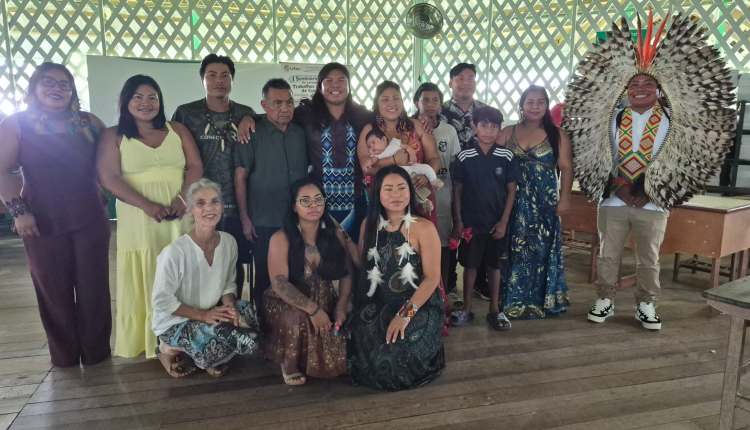
O curso de Licenciatura Indígena, do campus Floresta da Ufac, realizou o 1º Seminário Acadêmico de Apresentação de Trabalhos de Conclusão de Curso (TCCs). O evento possibilitou a defesa de 16 trabalhos nas aldeias Barão, da terra indígena Puyanawa, em Mâncio Lima (AC), e Morada Nova, na terra indígena Katukina/Kaxinawá, em Feijó (AC). As atividades ocorreram entre 25 de setembro e 2 de outubro, envolvendo estudantes, professores, egressos do curso, pós-graduandos e as comunidades locais.
Os TCCs defendidos nas aldeias são de autoria de discentes que ingressaram na Ufac em 2023 e deverão colar grau no início de 2027. Os temas das pesquisas contemplaram variados aspectos da vida indígena, abrangendo história, biografia, mitologia, organização política, território, medicina tradicional, grafismos, gênero, terminologias linguísticas, educação especial, atividade cinegética e rituais tradicionais.
A viabilização das defesas nas aldeias ocorreu pela primeira vez em 18 anos de existência da graduação e está de acordo com a pedagogia da alternância, pela qual parte da carga horária do curso é realizada nas comunidades indígenas dos alunos, por meio de pesquisa e extensão. Os recursos para realização do evento foram provenientes de projeto de extensão com o mesmo nome do seminário.
As bancas de avaliação foram compostas por docentes do curso, egressos de outras turmas da Licenciatura Indígena e egressos indígenas de outros cursos da Ufac, inclusive da pós-graduação. Também compuseram algumas bancas pessoas reconhecidas por suas comunidades com “notório saber”, expediente previsto no regulamento de TCC do curso. Além de familiares dos estudantes e moradores das aldeias, indígenas de outras etnias estiverem presentes no seminário.
Organização
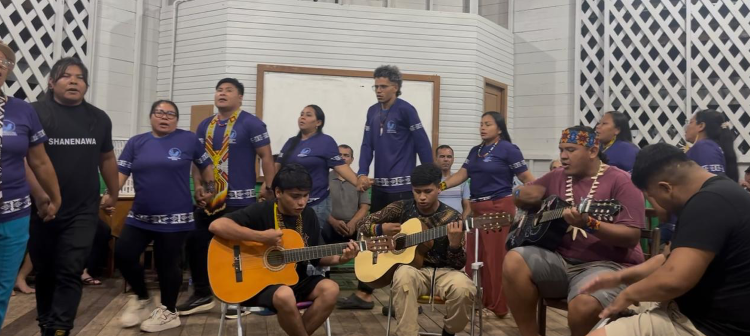
A atividade no município de Mâncio Lima, que é vizinho ao campus Floresta, em Cruzeiro do Sul (AC), ocorreu num só dia, em 25 de setembro, com a defesa de dois TCCs. Já para o evento em Feijó foi necessário um deslocamento de ônibus, com duração de quase seis horas, em 30 de setembro, até o porto da cidade. E, à noite, uma embarcação levou cerca de 20 pessoas até a aldeia Morada Nova, onde houve uma recepção musical para o grupo. Na manhã do dia seguinte começaram as defesas, que prosseguiram até 2 de outubro.
A servidora Júlia Gomes da Silva, curadora do Herbário da Ufac, vinculado ao Parque Zoobotânico (PZ), representou a instituição no 76º Congresso Nacional de Botânica e 15º Encontro de Botânicos do Centro-Oeste, eventos ocorridos de 11 a 16 de outubro, em Campo Grande. Ela participou de mesa-redonda com apresentação das coleções dos herbários da região Norte.
Na ocasião, os curadores discutiram avanços, desafios estruturais e o futuro das coleções científicas do país. Durante sua exposição, Júlia conduziu o público por uma linha do tempo que remonta a 22 de outubro de 1979, data da primeira coleta registrada no campus-sede da Ufac: uma ‘Vismia’ (gênero científico de planta) coletada por L. Coêlho. Em razão desse registro, o herbário da Ufac comemora 47 anos nesta quinta-feira, 22.
Júlia destacou perspectivas importantes para o cenário científico acreano. Entre os projetos de destaque estão investimentos viabilizados via Financiadora de Estudos e Projetos (Finep), incluindo a projeção de um novo prédio de cerca de 600 metros quadrados e a aquisição de armários compactadores modernos para garantir a preservação do acervo em longo prazo.
Também representaram a Ufac estudantes do campus Floresta, em Cruzeiro do Sul (AC), e a professora Simone Reis. A universidade enviou 11 resumos, dos quais oito foram apresentados. O evento possibilitou a troca de experiência com botânicos do país e conversas sobre parcerias de trabalho, incluindo a realização de expedições para grupos de plantas pouco estudados no Acre.
Herbário
O Herbário da Ufac tem uma equipe técnica composta por Júlia Gomes da Silva, Izailene Saar e colaboradores, como a ex-curadora e atual vice-reitora Almecina Balbino, o técnico Davi Borges e estagiários. O acervo abriga preciosidades da flora amazônica e sul-americana, registrando a superação de gargalos históricos de digitalização e integrando atualmente plataformas globais de dados de biodiversidade, como o SpeciesLink e o Global Biodiversity Information Facility.
Entre os marcos recentes destacados está o avanço na informatização de milhares de registros e a aposta em inovações, como a participação na Rede de Herbários Espectrais da Amazônia, que utiliza a espectroscopia no infravermelho próximo (tecnologia NIR portátil) para otimizar a identificação de espécies diante da escassez de taxonomistas na região.
A informatização completa do acervo ainda está em processo e figura como um dos principais objetivos da equipe, que agradeceu à direção do PZ e à Ufac pelo apoio contínuo aos servidores e à coleção, além de exaltar o esforço coletivo dos bolsistas, voluntários e parceiros que documentam, protegem e estudam a flora e funga brasileira.




 ACRE6 dias ago


Warning: Undefined variable $user_ID in /home/u824415267/domains/acre.com.br/public_html/wp-content/themes/zox-news/comments.php on line 48
You must be logged in to post a comment Login